

Municipal water treatment systems must separate unwanted solids without creating excessive head loss, frequent blockages, or high maintenance demands. Wedge wire screens are used in several stages of drinking-water and wastewater treatment because their continuous slots provide accurate separation while maintaining a relatively large open area.
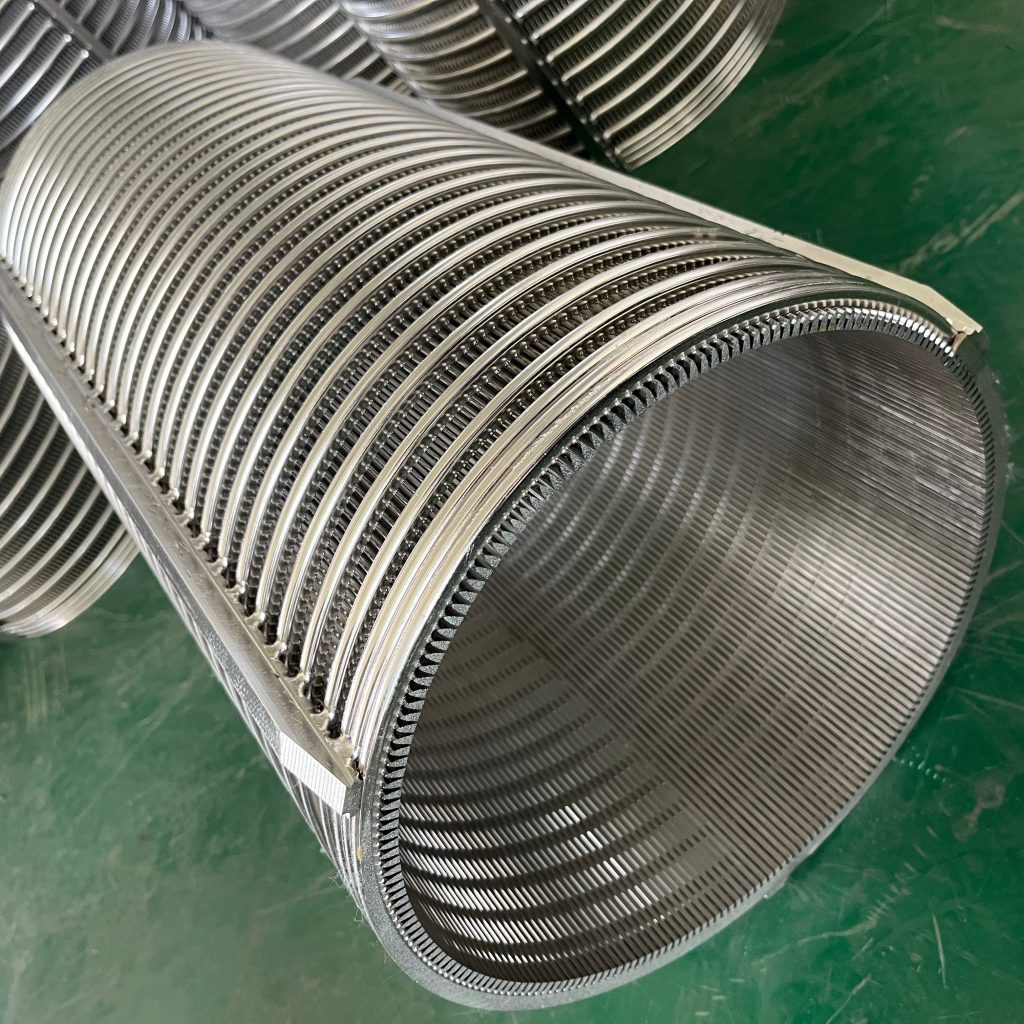
Unlike woven mesh, wedge wire screens are manufactured by welding profiled surface wires to supporting rods. The narrowest part of each slot is located at the screening surface, while the opening widens below it. Particles too large to pass remain on the surface, and smaller particles move through the widening slot. This geometry reduces the risk of particles becoming trapped inside the opening.
However, wedge wire is not one universal screen for an entire treatment plant. Its form, slot opening, wire orientation, material, and cleaning method must match the solids, flow conditions, and function of each treatment stage.
Where Wedge Wire Screens Are Used in Municipal Water Treatment
Municipal facilities use wedge wire elements in raw water collection, preliminary treatment, filtration, clarification, sludge processing, and final water distribution systems.
| Treatment location | Typical screen form | Primary function |
|---|---|---|
| Surface water intake | Cylindrical intake screen | Exclude debris, aquatic organisms, and suspended solids |
| Groundwater collection | Continuous-slot well screen | Admit water while controlling formation sand |
| Preliminary wastewater treatment | Rotary drum or static screen | Remove fibers, plastics, hair, and other solids |
| Filter underdrain | Screen laterals, nozzles, or panels | Retain media and distribute water or air |
| Clarifier or process tank | Launder screen or overflow screen | Prevent floating solids from leaving the tank |
| Sludge treatment | Drum, panel, or sieve-bend screen | Thicken sludge or recover water |
| Pump and equipment protection | Cylindrical strainer | Prevent solids from reaching downstream equipment |
Surface Water Intake Screening
Municipal drinking-water plants drawing from rivers, reservoirs, or lakes need to protect pumps and downstream treatment equipment from debris and aquatic material. Cylindrical wedge wire intake screens can be installed around intake pipes to create a controlled screening barrier.
The continuous-slot construction distributes flow across the screen surface. When the screen is correctly sized, this can reduce localized entrance velocity and associated hydraulic losses. Slot selection and total open area must be based on the required flow, the material to be excluded, seasonal debris loading, and any applicable environmental requirements.
Passive intake screens may also incorporate an air-burst or water-backwash system. Cleaning requirements should be determined during design rather than assuming that the V-shaped slots make the screen completely maintenance-free.
Municipal Water Wells and Infiltration Systems
Continuous-slot well screens are commonly used in municipal groundwater wells. Their purpose is to support the surrounding formation or gravel pack while allowing groundwater to enter the well.
The slot opening should be selected from a representative particle-size analysis of the formation or engineered gravel pack. Specifying an unnecessarily narrow slot can restrict flow and accelerate blockage. A slot that is too wide may allow sand to enter, causing turbidity, pump wear, or sediment accumulation.
Screen diameter, length, open area, entrance velocity, collapse strength, and material grade must therefore be considered together. Slot size alone does not determine whether a well screen will perform successfully.
Preliminary Wastewater Screening and Solids Removal
Raw municipal wastewater may contain rags, fibers, plastics, food residues, hair, and other suspended matter. Coarse bar screens usually remove large objects first. Wedge wire screens can then provide finer separation where smaller solids need to be removed before biological treatment, membrane systems, or other downstream processes.
Rotary Drum Screens
A rotary drum screen presents a curved wedge wire surface to the incoming wastewater. Depending on the equipment design, water passes through the slots while retained solids remain on the screening surface. Rotation carries the collected material toward a discharge or cleaning zone.
These screens can provide continuous operation and are commonly considered where the solids load would make a stationary fine screen difficult to manage. Their performance depends on slot width, drum diameter, rotational speed, hydraulic loading, spray cleaning, and the characteristics of the screenings.
Static and Sieve-Bend Screens
Static wedge wire screens use gravity and the shape of the screen surface rather than a motor-driven drum. On an inclined or curved sieve bend, liquid passes through the slots while solids continue down the screen face.
They contain fewer moving components, but this does not mean they suit every municipal wastewater stream. Fibrous or greasy material may accumulate if the screen angle, slot orientation, flow distribution, and cleaning arrangement are unsuitable.
Static screens are most effective when the feed is distributed evenly across the working width. Concentrated flow can overload one area while leaving the rest of the screen underused.
Filter Underdrains and Media Retention
Rapid sand filters, granular activated carbon filters, and other municipal filtration units require an underdrain system beneath the media. The underdrain must perform several functions:
- Retain the filter media
- Collect filtered water evenly
- Distribute backwash water across the bed
- Distribute air where air-scour cleaning is used
- Withstand the mechanical and hydraulic loads of operation
Wedge wire laterals, panels, and filter nozzles can be incorporated into these systems. Their continuous slots provide multiple discharge or collection points across the filter floor.
The design should not be based only on whether the screen opening is smaller than the media. Engineers must also evaluate hydraulic balance, allowable head loss, nozzle or lateral spacing, backwash rate, air distribution, and the risk of media migration.
In some systems, support gravel remains necessary even when wedge wire elements are used. Whether a gravel-free arrangement is appropriate depends on the media size, screen configuration, and complete underdrain design.
Sludge Thickening and Water Recovery
Municipal wastewater treatment generates primary sludge, waste-activated sludge, and other solids-bearing streams. Wedge wire screens can support gravity drainage, preliminary sludge thickening, and recovery of liquid from relatively coarse solid mixtures.
In a sludge-thickening application, free water passes through the slots while concentrated solids remain above the screen surface. The screen may be formed as a rotating drum, curved panel, or another equipment-specific element.
Performance depends strongly on sludge characteristics. Biological sludge containing deformable flocs behaves differently from mineral particles of the same nominal size. Polymer conditioning, feed solids concentration, flow rate, grease content, and screen-cleaning conditions can all affect solids capture.
For this reason, particle size alone is rarely sufficient for selecting a sludge screen. Pilot or sample testing is advisable when the sludge varies significantly or when capture efficiency is critical.
Why Wedge Wire Is Selected for Municipal Systems
The principal advantage of wedge wire is not simply that it is “non-clogging.” Its value comes from the relationship between surface geometry, open area, structural support, and cleanability.
Continuous, Accurate Slots
The slot is created between adjacent profile wires rather than by punching individual holes. This allows consistent openings along the screen surface when manufacturing tolerances are properly controlled.
Reduced In-Slot Blockage
Because the opening widens after the narrow screening point, particles that pass the surface have more space to move through. This reduces wedging within the slot compared with openings of uniform depth. Surface fouling can still occur, particularly with fibrous, biological, oily, or sticky material.
High Open Area
A suitable combination of slot width and surface-wire profile can provide significant open area. This helps distribute flow and manage pressure loss, although actual hydraulic performance must be calculated for the complete installation.
Mechanical Strength
Each surface wire is welded to multiple support rods. The profile and spacing of these components can be adjusted to accommodate external pressure, internal pressure, media loads, and handling requirements.
Compatibility with Cleaning Systems
Wedge wire surfaces can be configured for spray washing, air bursting, backwashing, brushing, scraping, or chemical cleaning. The correct method depends on the foulant and the screen arrangement.
How to Specify Wedge Wire Screens for Municipal Projects
A reliable specification begins with the process conditions, not a standard slot number.
1. Define the Separation Objective
Determine whether the screen must exclude river debris, retain filter media, remove wastewater solids, control formation sand, or protect a pump. These duties require different screen configurations.
2. Characterize the Solids
Record the particle-size distribution as well as particle shape, hardness, compressibility, grease content, fiber content, and expected concentration. Soft biological solids may deform through an opening that retains rigid particles of the same measured size.
3. Establish Hydraulic Conditions
Provide normal, peak, and minimum flow rates. Also define the acceptable head loss, operating water level, flow direction, and available screen area.
4. Select the Screen Form and Flow Direction
Possible forms include flat panels, curved sieve bends, cylinders, drums, laterals, and nozzles. The flat face of the profile wire should normally face the incoming solids so that separation occurs at the narrowest point and cleaning remains accessible.
5. Choose a Suitable Material
Stainless steels are widely used, but the grade should be selected according to chloride concentration, chemical exposure, temperature, cleaning chemicals, and corrosion risk. A higher alloy grade is not a substitute for reviewing actual water chemistry.
6. Plan the Cleaning Method
Specify how accumulated solids will be removed and how often cleaning may be required. Access for inspection and replacement should also be incorporated into the system layout.
Conclusion
Wedge wire screens can perform multiple functions in municipal water treatment, including raw water intake screening, well sand control, fine wastewater screening, filter-media retention, sludge drainage, and equipment protection.
Their performance depends on more than slot width. Solids behavior, open area, hydraulic loading, flow direction, structural strength, material compatibility, and cleaning method must be evaluated as one system. A screen selected from actual process data will generally provide more reliable separation and easier maintenance than one chosen from a broad application label alone.


