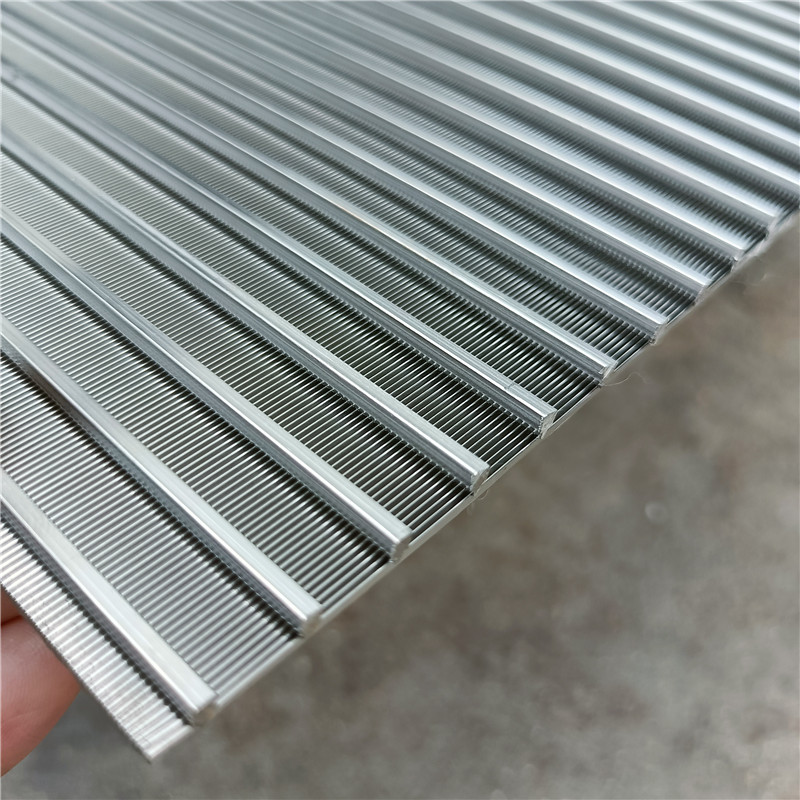
A wedge wire screen is a precision-engineered metal mesh element constructed by resistance-welding V-shaped profile wires onto parallel support rods. This rigid construction delivers continuous-slot particle filtration and high-volume fluid flow across processing operations. Process engineers specify this versatile filtration device to maintain minimal pressure drops during continuous fluid handling.
The smooth surface geometry prevents particulate clogging and reduces system maintenance requirements. Operators integrate wedge wire screens into liquid-solid separation systems to increase total daily throughput. Exceptional mechanical strength makes wedge wire screens a reliable component in industrial filtration systems. Precise slot dimensions deliver exact particle retention while maximizing overall process efficiency.
Wedge Wire Screen Structure and Components
Manufacturers construct a wedge wire screen through a precise electrical resistance-welding process. Automated assembly machinery aligns V-shaped profile wires across parallel support rods at exact, uniform intervals. The production system applies localized electric current and mechanical pressure at every contact point.
This process fuses each surface profile wire directly to the underlying support members, forming a single rigid assembly. The resulting welded joint creates a structural union across the entire panel surface. Consequently, the fabricated screen maintains its rigid structure under heavy dynamic forces, severe vibrations, and intense hydraulic loads without shifting position or altering slot dimensions.
V-Shaped Wire Profile and Continuous Slots
The continuous orientation of the surface wires forms uninterrupted open slots across the working screen face. This continuous slot geometry directly governs the operational capabilities of the component:
- Open Area: The ratio of total slot openings relative to the solid wire surface determines fluid throughput capacity and system head loss.
- Micron Ratings: The precise measurement between parallel wire crests establishes the specific size boundary for particle retention.
- Structural Tolerance: Consistent slot spacing across the full assembly surface ensures uniform flow distribution and predictable processing performance.
The cross-sectional profile of the individual surface wire features a wide outer face and a narrowing inner apex. This inward-widening geometry creates a narrow surface aperture that immediately expands into a wider internal relief channel. Fluid media passes easily through the widening slot space while solid particles larger than the slot gap remain on the exterior surface.
This continuous channel design improves solid-liquid separation efficiency by minimizing particle entrapping and surface blinding. Furthermore, continuous slot geometry provides high precision opening tolerances that maximize open filtration area and reduce fluid velocity across the screen face.
Alloy Selection and Parallel Support Rods
Parallel support rods positioned perpendicular to the surface wires provide essential structural reinforcement for demanding industrial operations. These internal support members carry the mechanical loads, absorbing high differential pressures and solid slurry impacts. Fabrication plants utilize various support rod geometries, including round bars, rectangular strips, and deep teardrop shapes, to meet specific structural load requirements.
| Alloy Grade | Primary Performance Characteristics | Typical Operating Environment |
|---|---|---|
| 300-Series Stainless Steel | High general corrosion resistance and excellent mechanical durability | Standard industrial water treatment and food processing systems |
| Duplex Stainless Steel | High yield strength with superior chloride pitting resistance | Heavy chemical processing plants and demanding offshore applications |
| Hastelloy | Exceptional resistance to severe chemical attack and extreme heat | Highly corrosive chemical synthesis and high-temperature processing |
Engineers select specialized metal alloys for both surface wires and support rods based on chemical exposure, operational temperature, and fluid acidity. Industrial facilities rely on 300-series stainless steel for standard fluid handling operations. Aggressive processing media requires Duplex alloys to resist stress corrosion cracking and pitting.
Processing plants handling severe chemical streams or high heat utilize Hastelloy components. Choosing the proper material preserves structural tolerance, prevents surface erosion, and maintains consistent filtration efficiency across extended processing cycles. Industrial operators specify wedge wire screens built from these resilient alloys to ensure continuous service life in harsh operating environments.
Wedge Wire Screen Working Principle
Mechanical fluid filtration systems rely on precise structural geometry to isolate solids from liquid streams. A wedge wire screen operates as a continuous surface barrier that intercepts suspended debris while granting passage to liquid media. The physical interaction between the solid particles and the V-wire profile determines the operational success of the unit.
Two-Point Particle Contact Mechanics
Traditional mesh filters utilize woven wires or punched metal sheets with square edges. These conventional designs feature parallel sidewalls that trap near-size solid particles within the filter openings. Solid materials become lodged deep inside the screen pores during continuous liquid processing. This entrapment causes severe surface blinding and reduces operational throughput across the system.
In contrast, a wedge wire screen utilizes a specialized two-point contact principle to maintain open fluid pathways. The flat, narrow top edge of each V-shaped profile wire faces the incoming fluid stream. Oversized particles collide only with the outer two corners of adjacent surface wires. This minimal contact zone prevents near-size particles from wedging tightly into the slot openings.
Particles smaller than the slot gap touch the narrow surface crest and immediately pass through the widening internal channel without clogging the filter.
Directional Flow and Self-Cleaning Dynamics
Liquid media experiences significant hydrodynamic changes while passing through the wedge wire profile. Fluid enters the narrow surface slot and immediately encounters an expanding internal relief channel. This rapid enlargement of the flow passage alters the pressure drop and fluid speed across the barrier:
- Entrance Compression: Fluid accelerates slightly as it enters the narrow slot opening at the screen surface.
- Expansion and Pressure Drop: The expanding inner V-shape increases the available cross-sectional flow area, causing fluid pressure to drop instantly behind the surface wire.
- Velocity Surge: The abrupt differential pressure generates a localized velocity surge through the discharge side, pulling fine particles past the aperture.
This fluid expansion dynamic creates an active self-cleaning effect during continuous liquid processing. The sudden drop in fluid pressure prevents fine solids from settling on the internal metal surfaces. Liquid turbulence washes the lower wire walls clean, preserving processing efficiency during long production cycles.
Industrial processing operations utilize two primary flow configurations based on system piping layouts and vessel design:
| Flow Configuration | Description | Direction of Liquid Flow | Primary Application |
|---|---|---|---|
| Outside-In (FITO / FOTI) | Fluid flows from the exterior surface toward the inner internal core | From outside to inside across the profile wire face | External surface straining and industrial wastewater treatment |
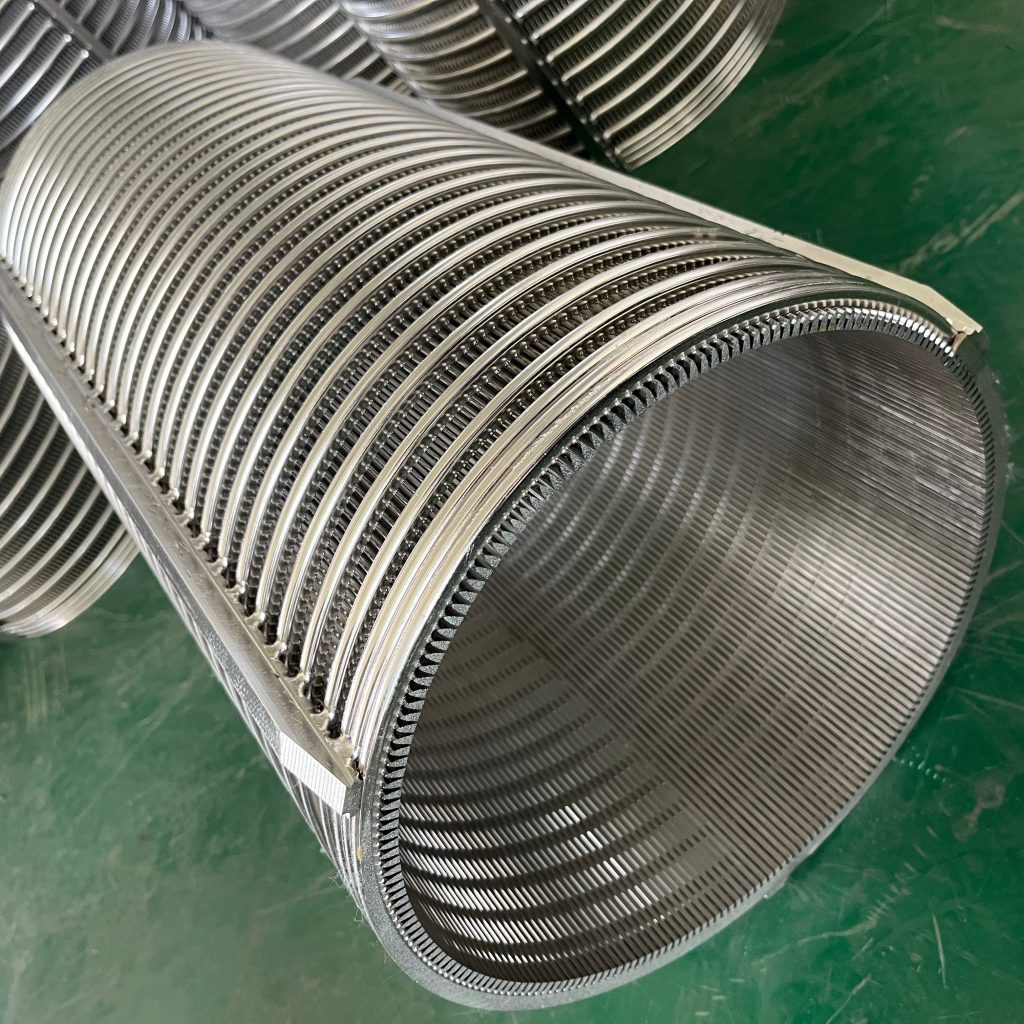
| Inside-Out (FITI / FOTO) | Fluid flows from the central inner chamber toward the outer shell | From inside to outside across the profile wire face | Internal media retention, rotating drum screens, and pressure vessels |
In Outside-In configurations, solids collect on the smooth exterior screen face where scraping blades or backwash jets easily remove accumulated debris. In Inside-Out setups, heavy solids settle inside the internal cylinder basket for controlled slurry collection. Both flow orientations maintain strict particle separation tolerances across industrial water systems.
Industrial Applications for Wedge Wire Screens
Efficient Solid-Liquid Separation and Dewatering
Industrial processing plants rely on specialized screens for efficient solid-liquid separation and dewatering tasks. Slurry flows directly across a tilted screen surface during municipal wastewater treatment. Free water drains rapidly through uniform slot openings under natural gravity forces.
The continuous mechanical screen retains wet organic solids on its upper surface. Stationary run-off screens handle high fluid volumes without dynamic electrical power inputs. This passive drainage mechanism lowers overall energy costs across municipal water management facilities.
Mining facilities and food processing plants also use vibrating screen decks to remove surface moisture from heavy bulk solids. Operators select specific equipment designs based on precise processing goals:
- Run-of-Mine Dewatering: Slurry passes across flat screen panels to recover clean process water.
- Food Starch Washing: Plant operators pass sliced vegetable pulp over static curved screens to isolate starch liquid. High-frequency vibration shifts heavy solids along the metallic surface. Liquid drops freely into lower collection pans without blinding fluid filtration channels. Continuous drainage maintains uniform cake dryness across high-volume production lines.
Media Retention and Particle Classification
Chemical plants utilize a wedge wire screen as a media retention barrier in catalyst vessels and ion-exchange towers. Internal strainer nozzles hold active resin beads inside processing tanks during continuous fluid flow. The high mechanical strength of welded metal supports packed media beds under severe pressure differentials.
These robust assemblies prevent loss of valuable media during routine backwashing cycles. Properly designed retention screens preserve active chemical volume and eliminate media downstream migration.
Industrial facilities install wedge wire screens for precise particle classification and material sizing. Processing systems move dry or wet minerals across screen surfaces with distinct slot widths. Oversized particles move forward while smaller grains pass through the opening gaps.
This process achieves efficient separation for mineral processing operations. Engineers integrate these resilient components into industrial filtration systems to maximize process efficiency and protect downstream equipment. Uniform aperture sizing ensures steady material throughput across extended production runs.
Conclusion
A wedge wire screen provides vital engineering advantages for modern industrial operations. Uninterrupted continuous slots allow steady fluid flow and prevent debris entrapment during continuous processing. Solid profile wires give wedge wire screens high mechanical strength under severe hydraulic loads. Rigid construction maintains exact slot dimensions to ensure precise particle separation and accurate filtration across every production cycle.
These robust structural properties eliminate surface blinding and protect critical downstream equipment. Consequently, processing plants reduce manual cleaning cycles and lower routine maintenance costs over extended operational runs. Installing durable wedge wire screens optimizes overall processing efficiency and enhances system reliability in all industrial fluid management systems.
FAQ
What is a wedge wire screen?
A wedge wire screen is a filtration and separation screen made from V-shaped profile wires welded to support rods. The precisely controlled slots allow liquids or fine materials to pass through while retaining larger solid particles.
How does a wedge wire screen work?
A wedge wire screen separates materials according to particle size. Liquid or smaller particles pass through the continuous slots, while larger particles remain on the screen surface. The V-shaped wire creates openings that widen inward, helping reduce clogging.
How do wedge wire screens prevent clogging?
The V-shaped wire profile creates a narrow opening at the outer surface. Oversized particles contact only two points on the wire edge. The inner channel widens immediately. Fluid and fine debris pass through the expanding space without clogging the filtration element.
Which materials work best for corrosive industrial fluids?
Stainless steel alloys provide strong resistance against chemical attack and rust. Operators select 300-series stainless steel for standard water applications. Duplex stainless steel resists chloride pitting in harsh media. Extremely aggressive chemicals require specialized alloys like Hastelloy to maintain long-term structural integrity.
What makes wedge wire screens suitable for water treatment?
High mechanical strength allows wedge wire screens to handle strong hydraulic pressure. Continuous slots provide a large open area for high volume flow. This efficient design improves water treatment operations by retaining media securely and reducing routine manual cleaning requirements.
What is the difference between outside-in and inside-out flow configurations?
Flow direction depends on system design. Outside-in flow moves fluid from the exterior boundary toward the inner core for outer surface straining. Inside-out flow directs fluid from the central chamber outward, which helps retain internal media and collect heavy solids inside rotating baskets.