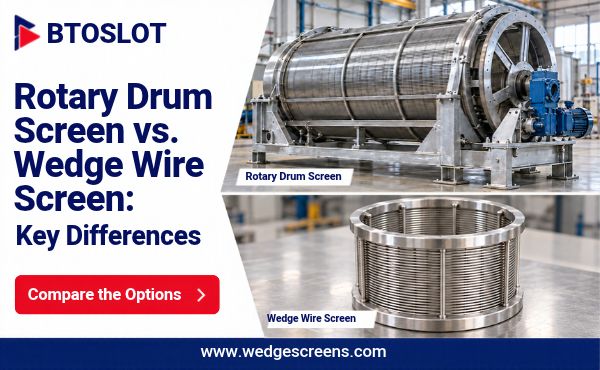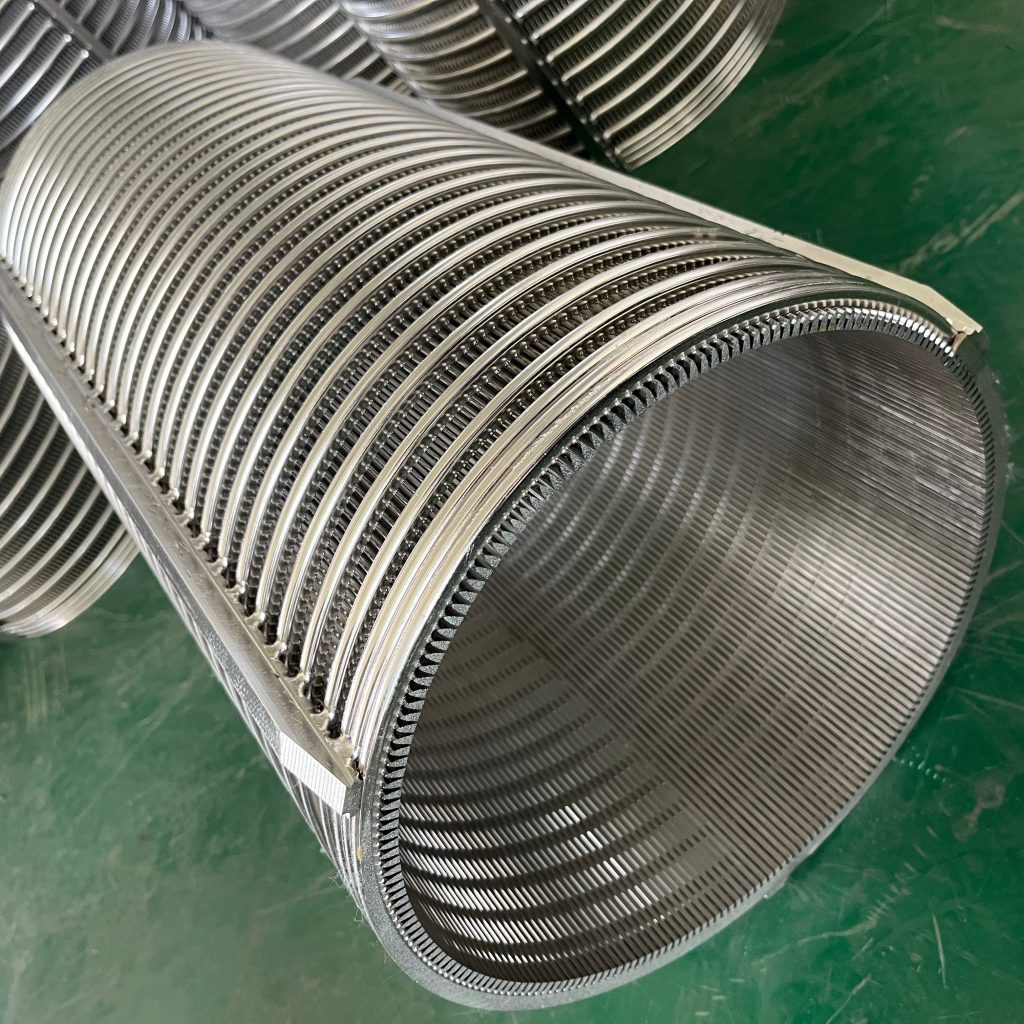
A rotary drum screen and a wedge wire screen describe different things. A rotary drum screen is a machine configuration that separates solids as a cylindrical screen rotates. Wedge wire is a screen construction made from profile wires joined to supports. A rotary drum screen can therefore contain wedge wire, perforated plate, or other screening media.
For buyers comparing these terms, the useful decision has two parts: selecting the equipment arrangement and selecting its screening surface. This guide focuses on industrial liquid–solid separation, where the distinction affects throughput, solids capture, cleaning, and replacement specifications.
Equipment Types and Screening Media
Rotary drum screens usually include more than the screening cylinder. The supplied package may contain a feed box, frame, drive, wash system, collection trough, and solids discharge arrangement. Its performance depends on how these parts work together.
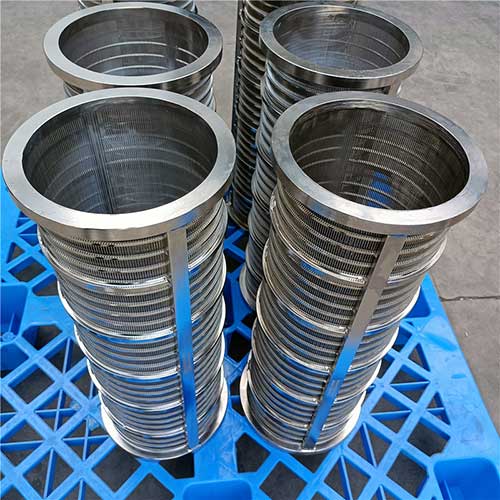
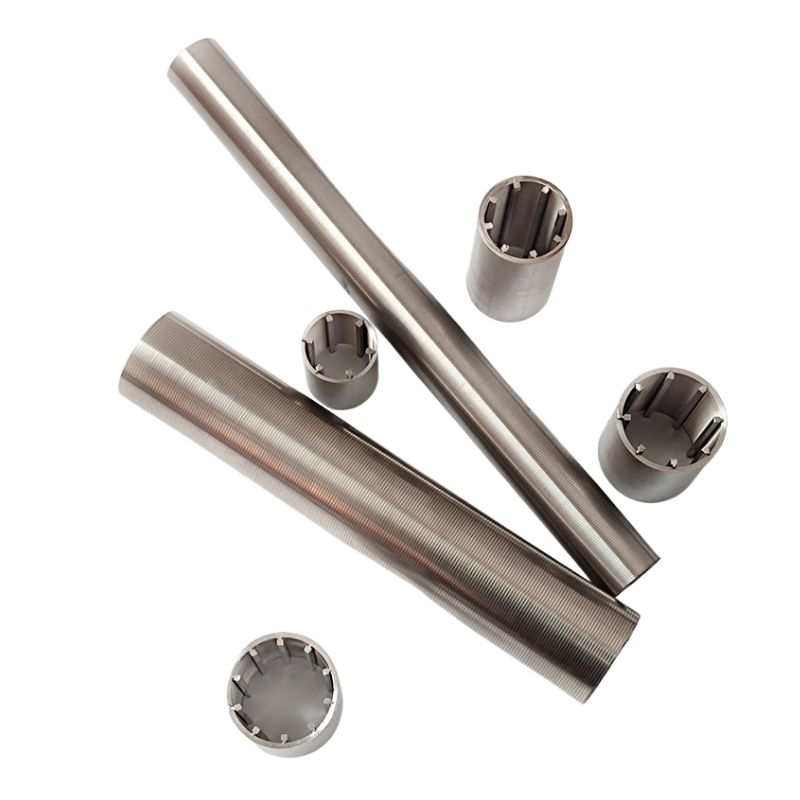
Wedge wire screens are screening components. They can take the form of flat panels, curved sieve bends, cylinders, baskets, or intake elements. Some operate in stationary equipment; others rotate or work with scrapers and backwashing systems.
Calling one option “rotary” and the other “wedge wire” therefore mixes equipment motion with screen construction. Before comparing quotations, establish whether each supplier is offering complete machinery or only the screening element.
| Purchasing term | What it describes | What buyers must clarify |
|---|---|---|
| Rotary drum screen | Equipment with a rotating screening cylinder | Package scope, feed arrangement, drive, and cleaning |
| Wedge wire screen | A profile-wire screening surface | Shape, slot opening, supports, and flow direction |
| Wedge wire rotary drum screen | A rotating machine using wedge wire media | Both machinery performance and cylinder specification |
| Static wedge wire screen | A stationary screening arrangement | Feed distribution, solids removal, and cleaning access |
Feed Arrangements and Solids Handling
Internally Fed Rotary Drum Screens
In an internally fed arrangement, feed enters the drum interior. Liquid passes through the screening surface, while retained solids remain inside and move toward the discharge through the machine’s transport arrangement.
Feed distribution matters. Concentrating liquid on a small section can overload that area while leaving other screen surfaces underused. Ask how the headbox distributes flow and how the equipment handles changes in solids loading.
Also confirm what happens after separation. Screening does not necessarily produce dry solids. Conveying, drainage, compaction, or additional dewatering may be separate functions or downstream equipment.
Externally Fed Rotary Drum Screens
Externally fed screens distribute liquid onto the outside of a rotating drum. Liquid passes through the screening surface, and retained material is removed from the exterior, often by a scraper or doctor blade.
This arrangement can suit industrial wastewater duties, but suitability depends on the actual solids and machine design. Grease, soft residues, and fibrous material require attention to discharge, scraper contact, and wash access.
Neither feed arrangement is universally superior. Compare the proposed designs against the same flow conditions, feed characteristics, available installation space, and required discharge condition.
Wedge Wire and Perforated Drum Media
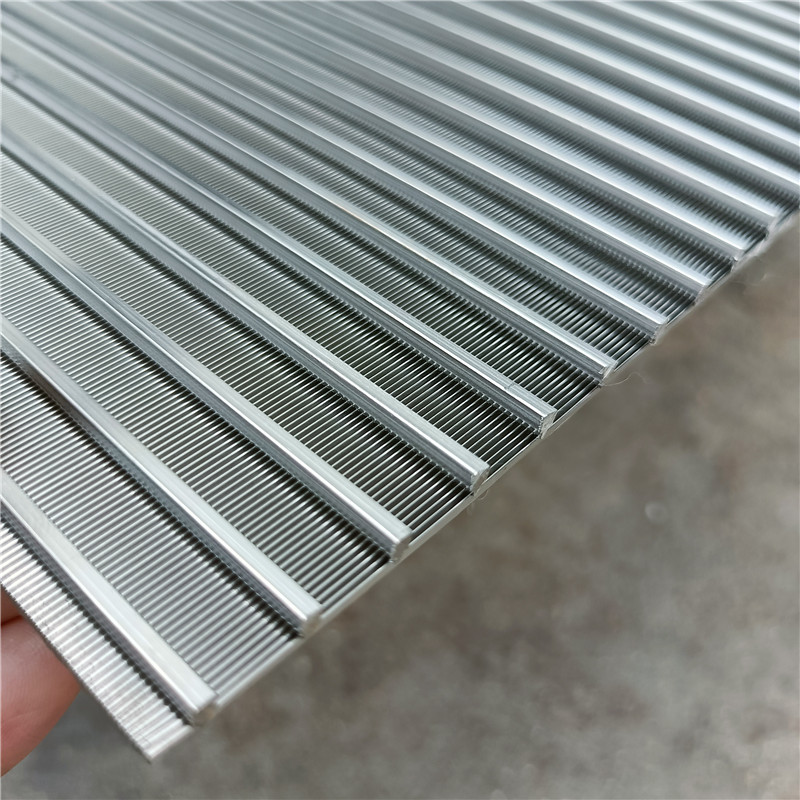
Wedge wire forms continuous slots between adjacent profile wires. In the intended filtration direction, the narrow opening is normally at the working surface and widens behind it. This geometry can reduce particle wedging, but it does not prevent surface deposits or fibrous mats.
Perforated plate uses discrete holes rather than continuous slots. The opening constrains particle passage in two dimensions, which can improve capture of some elongated solids compared with slotted media. That advantage remains dependent on hole size, particle shape, orientation, and operating conditions.
Equal nominal openings do not guarantee equal separation. A narrow fibre may align with a slot and pass through even when its length is much greater than the slot width. Flexible particles can also deform.
For critical capture requirements, request trials with representative feed. Assess both the retained material and the screened liquid; a visually impressive solids discharge alone does not establish downstream protection.
Hydraulic Capacity and Separation Performance
A rotary drum screen’s rated flow cannot be inferred from drum diameter or slot size alone. Effective screening area, available hydraulic head, feed distribution, liquid properties, solids loading, and fouling all affect operating capacity.
For wedge wire media, surface open area also changes with profile-wire dimensions and slot opening. Supports and structural features can further affect the available flow path. A larger gross area is not automatically a larger usable area.
Buyers should distinguish clean-screen capacity from capacity under expected operating deposits. A design that passes the required flow when freshly washed may struggle during peak loading or after its cleaning system deteriorates.
Use one shared duty specification when comparing proposals:
- Normal and peak flow, including short surges.
- Solids concentration and representative particle shapes.
- Liquid temperature, viscosity, and relevant chemistry.
- Required capture or downstream protection objective.
- Available head and acceptable upstream water level.
- Cleaning-water supply and solids discharge constraints.
A useful acceptance test should specify the feed conditions, sampling points, operating duration, and measured result. Without these boundaries, two suppliers may report capacity or capture using different methods, making their performance claims difficult to compare.
Ask suppliers to explain their assumptions and identify conditions requiring testing. Avoid treating slot width as an absolute filtration rating unless the retention claim has been defined and demonstrated.

Cleaning Systems and Operating Demands
Rotation continually presents different portions of the drum to the feed and cleaning zones. Depending on the equipment, solids removal may use scrapers, brushes, spray bars, or combinations of these features.
A stationary wedge wire screen has no screen-rotation drive, but the overall installation may still require pumps, valves, cleaning equipment, or powered solids handling. “Static” does not automatically mean zero energy consumption or zero maintenance.
Likewise, wedge wire is not inherently self-cleaning. Its slot geometry helps reduce lodging; persistent films, grease, biological growth, and mineral deposits can still obstruct the surface.
Compare cleaning systems by their operating requirements: water quality, pressure at the nozzles, consumption, cleaning frequency, drainage, and accessibility. Confirm whether cleaning works during operation or requires an interruption.
Maintenance scope also differs. Complete rotary equipment adds drive, bearing, alignment, and scraper checks to screen inspection. Component-only comparisons omit these obligations and can give buyers a misleading view of ownership cost.
Equipment Selection and Purchase Scope
Rotary drum equipment deserves consideration when the process needs ongoing screening and coordinated solids discharge. A static wedge wire arrangement may suit duties where gravity flow, simpler mechanics, and manageable solids accumulation fit the process.
These are selection starting points, not guaranteed outcomes. Sticky feed, limited hydraulic head, stringent capture requirements, or restricted cleaning access can change the preferred arrangement.
Compare complete installed scope rather than purchase price alone. Include feed piping, supports, controls, cleaning utilities, discharge handling, installation access, and expected maintenance labour. Clarify which items each proposal excludes.
For replacement drums, provide the approved drawing and original operating duty. Confirm cylinder dimensions, slot tolerance, flow direction, wire orientation, mounting details, support arrangement, and material specification. Matching diameter and length alone does not establish interchangeability.
Also verify whether the replacement is structurally suitable for rotation, cleaning loads, and contact with existing solids-removal equipment. An apparently similar cylinder may require different clearances or support.
Conclusion
Rotary drum screens and wedge wire screens are not competing categories. One describes equipment motion and arrangement; the other describes the screening surface. Define the required machine functions first, then compare media against the actual feed and capture objective. A sound purchase specification connects hydraulic performance, solids handling, cleaning, and replacement compatibility.